Nature & Wildlife
A hilly island in the largest lake in Africa – forests, sacred groves, birds and the changing ecology of Lake Victoria.
Topics
The island
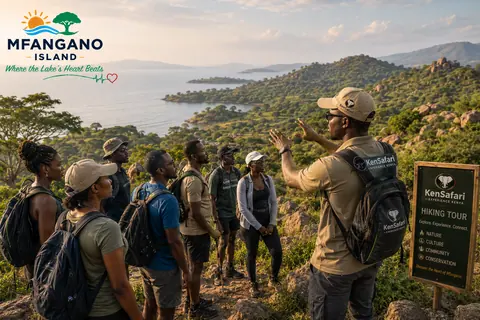
Mfangano covers about 65 to 66 square kilometres 1,2,3 and is larger than neighbouring Rusinga (44 km²) 4. Mount Kwitutu, the highest point, rises about 560 metres above the lake 2; since the lake lies at about 1,135 metres, that is roughly 1,690 metres above sea level (other sources give 1,694 m) 5. The terrain is rocky and hilly; villages such as Kagungu lie several hundred metres above the shore 2.
Climate
There are two rainy seasons: the long rains from March to June and the short rains around November and December. The mean temperature is about 25 °C 2. The county development plan gives slightly different months for the short rains 6.
Forests and sacred groves
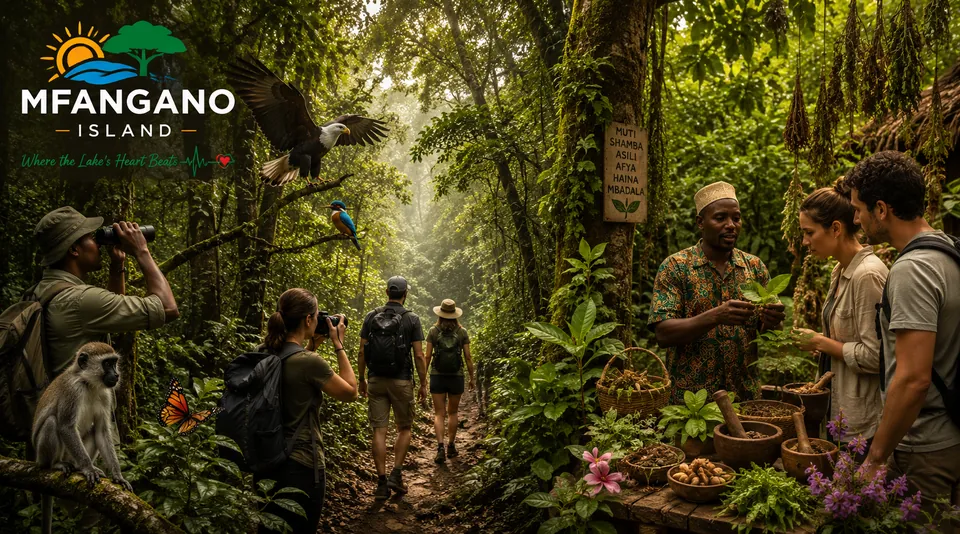
UNESCO describes thick forest and shrubs on the lower slopes and patches of forest and grassland on the hilltop 7. The sacred groves protected by the clans are among the last refuges of old trees 8. Much of the main hill has turned into shrubland through charcoal burning and clearing for farms; seedlings are handed out at monthly public meetings to encourage tree planting 6,9.
Animals and birds
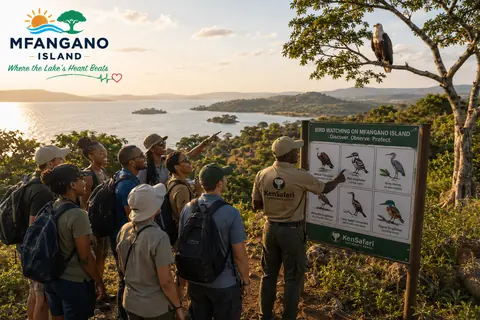
Tourism operators report spotted-necked otters, Nile monitor lizards, fish eagles and cormorants, and speak of more than 350 bird species in the wider area 10,11,12. These are reports from operators and guidebooks, not scientific surveys.
The lake
Nile perch were introduced into Lake Victoria in the mid-1950s against the advice of scientists 13,14. The predator contributed to the loss of more than 200 native cichlid species 14. Between 2002 and 2014 the Nile perch itself declined sharply near the shore, and illegal small-meshed nets and beach seines add to the pressure on fish stocks 1. In 2025 water hyacinth again blocked beaches and boats in Homa Bay County 15.
Sources
- Fiorella, K. J. et al.: "Human health alters the sustainability of fishing practices in East Africa". PNAS 114, 2017. doi.org
- Idris, Z. M. et al.: "High and Heterogeneous Prevalence of Asymptomatic and Sub-microscopic Malaria Infections on Islands in Lake Victoria, Kenya". Scientific Reports 6, 2016, 36958. doi.org
- Kenya National Bureau of Statistics: 2019 Kenya Population and Housing Census, Volume II – Distribution of Population by Administrative Units, 2020. knbs.or.ke
- Homan, T. et al.: "Profile – The Rusinga Health and Demographic Surveillance System, Western Kenya". International Journal of Epidemiology 45(3), 2016, 718–727. doi.org
- Nation: "Mfangano, an island looking for tourists" (c. 2010). nation.africa
- County Government of Homa Bay: County Integrated Development Plan 2023–2027. maarifa.cog.go.ke
- UNESCO World Heritage Centre / National Museums of Kenya: "Mfangano Island Rock Art Sites", Tentative List ref. 6682, submitted 30 June 2023. whc.unesco.org
- Ogola, P. O., Ogol, C. K. P. O. & Khayota, B.: "Sacred groves (kibaga) of Mfangano Island, Lake Victoria, Kenya", 2004. Maseno University repository. repository.maseno.ac.ke
- Nation: "Fading jewel – The environmental crisis threatening Mfangano Island", 19 March 2026. nation.africa
- The Governors' Camp Collection: "Mfangano Island Camp" (blog), 30 June 2019. governorscamp.com
- Gamewatchers Safaris / Porini: "Visit Mfangano Island Camp", 2024. porini.com
- Frommer's: "Things to Do in Lake Victoria". frommers.com
- Pringle, R. M.: "The origins of the Nile perch in Lake Victoria". BioScience 55(9), 2005, 780–787. collaborate.princeton.edu
- IUCN SSC Invasive Species Specialist Group: Global Invasive Species Database – Lates niloticus. iucngisd.org
- The Standard: "Livelihoods at risk as water hyacinth spreads in Lake Victoria", 2 September 2025. thestandard.ke
Last checked: 13 October 2026