History of the Island
From fossils and ancient rock paintings to the Abasuba and the island today – what published sources tell us, and where they disagree.
Deep time
The rocks of Mfangano and neighbouring Rusinga include land sediments from the early Miocene, roughly 18 to 20 million years old, which researchers use to reconstruct the climate of that age 1. Fossils of the early apes Proconsul nyanzae and Proconsul heseloni are known from both islands 2. These finds belong to palaeontology – they are far older than any human history.
The rock paintings
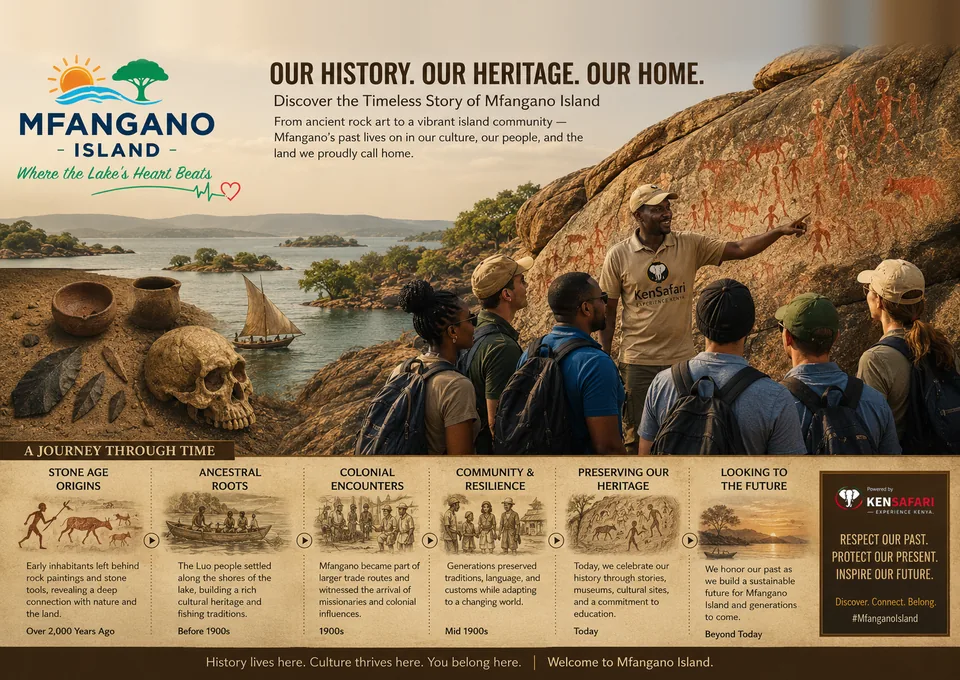
The best-known heritage of the island are its painted rock shelters. The two main sites are Kwitone, a long overhang below Itone Hill inland, and Mawanga, a cave close to the shore 3,4,5. The paintings are geometric – concentric circles, spirals, ovals and sun-like shapes – and were applied with the fingers, probably with red haematite and white clay 4. Sources describe the colours at Mawanga differently: white and red, or white and black 3,4.
Their age is estimated at between 1,000 and 4,000 years; no laboratory date has been published 3,4,5. The art is generally attributed to earlier hunter-gatherer groups, often identified as Twa (Batwa), and belongs to a tradition of geometric rock art around Lake Victoria. The Abasuba came later and adopted the sites 3,4.
The sites have remained part of living culture. The Wagimbe clan are the custodians of Kwitone and the Wasamo clan of Mawanga. Both sites are associated with rain-making; Wasamo elders told researchers that Mawanga was used for rain rituals until a few decades ago 3,4,5. A third site, Kakiimba, is linked in tradition to sacrifices and peace talks 5.
Archaeologist James Chaplin examined Kwitone in the 1960s 4. In 2000 David Coulson of the Trust for African Rock Art (TARA) recorded the paintings, and in August 2005 TARA and the community opened the sites to visitors, with piers, signs and boats paid for in part by the Tourism Trust Fund 6. In June 2023 the National Museums of Kenya placed the "Mfangano Island Rock Art Sites" on Kenya's Tentative List for UNESCO World Heritage 3; in January 2024 a joint entry for the geometric rock art of the Lake Victoria region in Kenya, Tanzania and Uganda followed 7.
"abstract patterned paintings thought to have been created between 1,000 and 4,000 years ago"British Museum, African Rock Art Image Project 4
The Abasuba and their arrival
The Abasuba (Suba) are a Bantu-speaking people of the islands and shores of north-eastern Lake Victoria. Through long contact and intermarriage they have been strongly influenced by their Nilotic Luo neighbours 3,5,8. Their traditions name Uganda, and especially Buganda, as their origin; some groups are said to have travelled by way of Tanzania 5. Elders point to words shared with Luganda, such as Katonda for God, and describe how their ancestors crossed the lake from island to island 9.
When the Abasuba reached Mfangano is not known precisely. Published dates range from about the 17th century to roughly two hundred years ago. They come from oral tradition and are best read as a range 4,5,10. One Mfangano tradition tells of the brothers Witewe and Kiboy, who fled Buganda after the killing of a king and settled on the island. Witewe's descendants, the Wetete clan, still keep his shrine forest near the summit 10.
Tradition also explains the names of the island. "Ivangano", meaning reconciliation, is said to recall a ceremony that ended a feud in the 17th century, and "Mfangano" is linked to a Suba word meaning "to unite" 3,5. The Abasuba were organised in clans with ritual duties such as rain-making; groups named as early inhabitants of the island include the Wakisori, Wakisasi, Walowa, Wagimbe, Waganda and Wakiaya 5.
The colonial period
Under British rule (1900–1963) the area belonged to South Kavirondo District 11. Sleeping sickness reached Kenya from Uganda around 1901 and spread along the shores and islands of Lake Victoria; in South Nyanza the tsetse fly was only brought under control by insecticide campaigns from 1950 12. Elsewhere in the lake whole islands were evacuated – Mageta several times until about 1922, and in Uganda mass removals began in 1906 13,14. None of the sources we found states that Mfangano itself was evacuated.
The colonial period also accelerated the shift from the Suba language to Dholuo. Schooling, Bibles and interpreters in Dholuo, and marriages between Suba men and Luo women are named as causes 8,15. Reliable published sources on the first missions and schools on Mfangano have not yet been found – this chapter of the island's history still has to be written.
After independence
Suba District was created in 1995, carved out of Homa Bay District, with Mbita as its headquarters 16. Since the general election of 2013 Mfangano belongs to Homa Bay County; Mfangano Island is one of the county wards of Suba North constituency 11,17. In 2022 the islands received their own sub-county with headquarters at Sena on Mfangano, so that residents no longer have to cross to Mbita for identity cards, certificates and land documents 18,19. Later sources call it Suba Central or Suba West 20,21.
The Abasuba Community Peace Museum was founded in 2000 by Jack Obonyo on family land at Ramba. Its aim is to protect the heritage of a small community and to keep traditional ways of making peace alive 6. Its new building opened on 17 October 2008 6,22. Since 2012 private ferries have linked the island with Mbita 23, and in 2023 work began to upgrade a ring road of more than 50 km around the island to gravel standard 24.
Open questions
The sources disagree on the date of the Abasuba arrival, the colours at Mawanga, the age of the paintings and the name of the sub-county. We show the different statements side by side. If you have documents, photos or knowledge about the history of Mfangano – especially about the first churches and schools – please write to us.
Sources (24)
- Michel, L. A. et al.: "Paleoclimatic and paleoecological reconstruction of early Miocene terrestrial equatorial deposits, Rusinga and Mfangano Islands". AGU, 2012. repository.maseno.ac.ke
- Walker, A., Teaford, M. F., Martin, L. & Andrews, P.: "A new species of Proconsul from the early Miocene of Rusinga/Mfangano Islands, Kenya". Journal of Human Evolution 25(1), 1993, 43–56. researchconnect.stonybrook.edu
- UNESCO World Heritage Centre / National Museums of Kenya: "Mfangano Island Rock Art Sites", Tentative List ref. 6682, submitted 30 June 2023. whc.unesco.org
- British Museum, African Rock Art Image Project: "Mfangano Island, Kenya". africanrockart.britishmuseum.org
- Coulson, D., Borona, G. K. & Nyasuna-Wanga, G.: Abasuba Natural and Cultural Heritage and Mfangano Island. Trust for African Rock Art, 2014. s3.amazonaws.com
- Nyasuna-Wanga, G. & Borona, G. K.: Managing Community Projects – TARA and the Abasuba Community Peace Museum. Trust for African Rock Art, c. 2010. africanrockart.org
- UNESCO World Heritage Centre / National Museums of Kenya: "Geometric rock art in Lake Victoria Region of Kenya, Tanzania, and Uganda", Tentative List ref. 6737, submitted 31 January 2024. whc.unesco.org
- Endangered Languages Project: "Suba". endangeredlanguages.com
- Nation (Nation Media Group): "Nilotes or Bantus? Debate rages as the Suba face identity threat". mwananchi.co.tz
- African Digital Heritage: "Witewe – The Suba Journey to Mfangano Island", 13 December 2023. africandigitalheritage.org
- County Government of Homa Bay: "History". homabay.go.ke
- Wellde, B. T. et al.: "A history of sleeping sickness in Kenya". Annals of Tropical Medicine & Parasitology 83, Suppl. 1, 1989, 1–11. doi.org
- Carpenter, G. D. H.: "Report on an investigation into the epidemiology of sleeping sickness in Central Kavirondo, Kenya Colony". Bulletin of Entomological Research 15(2), 1924, 187–208. cambridge.org
- Headrick, D. R.: "Sleeping Sickness Epidemics and Colonial Responses in East and Central Africa, 1900–1940". PLoS Neglected Tropical Diseases 8(4), 2014, e2772. pmc.ncbi.nlm.nih.gov
- Mhando, J. (National Museums of Kenya) for UNESCO Nairobi: Safeguarding Endangered Oral Traditions in East Africa, January 2008. ich.unesco.org
- Africa-Press: "Fond memories – President Moi gave us identity, Suba leaders say", 5 February 2020. africa-press.net
- County Government of Homa Bay: County Integrated Development Plan 2023–2027. maarifa.cog.go.ke
- Kenya News Agency: "Gov't creates new sub-county in Homa Bay", 21 March 2022. kenyanews.go.ke
- Kenya News Agency: "New sub county created for the residents of Lake Victoria islands", 21 October 2022. kenyanews.go.ke
- Kenyans.co.ke: "CS Kithure Kindiki Gazettes 16 New Sub Counties", 15 February 2024. kenyans.co.ke
- Nation: "Fading jewel – The environmental crisis threatening Mfangano Island", 19 March 2026. nation.africa
- Coulson, D. & Little, T.: "Dangers for African rock art, traveling exhibitions and the Abasuba Peace Museum". XXIII Valcamonica Symposium, 2009. ccsp.it
- The Standard: "After state failure to run ferries, firms take over lake transport", 27 January 2022. standardmedia.co.ke
- Kenyans.co.ke: "Govt Addresses Lack of Tarmac Road in Mfangano", 12 September 2023. kenyans.co.ke
Last checked: 13 October 2026